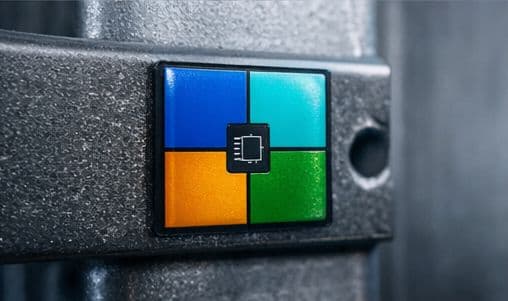
4-colour coded marker with embedded ultra-low-power Bluetooth chip
Colour vision meets wireless identity
Each XMarker carries two layers of information: a visual colour pattern that NanoEye cameras detect optically, and a low-energy Bluetooth chip that broadcasts a unique identifier.
Visual Layer
The 4-square colour pattern creates a unique visual code for each rack location. NanoEye cameras detect and decode these patterns in real time from up to 8 metres away, even in low-light warehouse conditions.
- 4 colours, 4 quadrants = thousands of unique combinations
- Readable at up to 8m distance
- Works in low-light and cold storage
- No power source required for visual detection
Wireless Layer
Each XMarker embeds an ultra-low-power Bluetooth chip that harvests energy from ambient radio signals. It broadcasts a unique slot ID that NanoEye can cross-reference with the visual pattern.
No battery replacements. The chip harvests energy from ambient RF signals and transmits its identifier periodically.
- Bluetooth Low Energy (BLE) broadcast
- Ambient energy harvesting — no battery changes
- 10-year+ operational lifespan
- Cross-references with visual colour code
Why XMarkers
Zero Infrastructure
Peel and stick. No wiring, no power outlets, no wireless access points needed at each rack.
Slot-Level Precision
Every rack slot gets a unique identity. NanoEye knows exactly where each pallet was placed.
No Maintenance
Energy-harvesting chips mean no batteries to replace. Install once and forget for 10+ years.
Dual Redundancy
Visual + wireless identification means the system works even if one layer is temporarily obscured.
Warehouse-Grade
UV-resistant, waterproof adhesive backing rated for cold storage, high-bay, and cross-dock environments.
Scalable
Thousands of unique marker codes available. Scale from a single aisle to an entire warehouse network.
Install in seconds
Each XMarker has a pre-applied industrial adhesive backing. Peel, position on the rack beam, press. The Atlas platform automatically maps each marker to its slot location during initial calibration.
Peel backing
Position on rack beam
Press to adhere
Auto-mapped by Atlas